


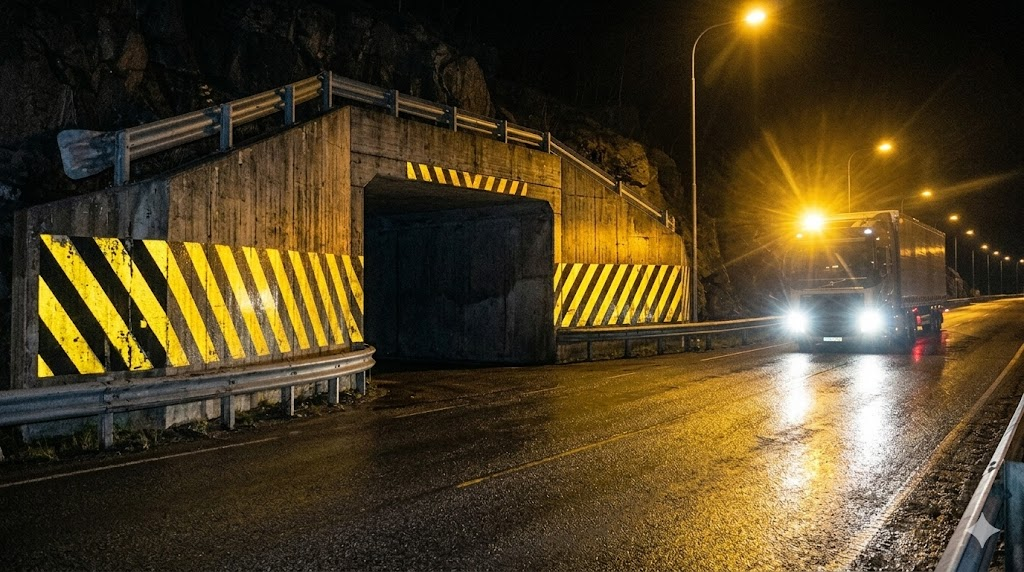
Horizontal road lines are only one part of the comprehensive traffic safety equation. Vertical structures, such as concrete tunnel entrances, bridge pillars, and corrugated steel guardrails, pose immense collision risks, especially in low-light environments or unlit rural areas.
Applying a highly visible светоотражающее покрытие to these specific vertical hazard surfaces drastically reduces accident rates. It provides drivers with clear, unbroken spatial boundaries and geometric guidance.
Unlike standard architectural paints that degrade quickly outdoors, an industrial-grade светоотражающая фасадная краска is engineered to bond permanently to complex substrates. It successfully transforms invisible roadside hazards into brightly illuminated, life-saving guides.
The Engineering Challenge of Vertical Infrastructure
Concrete Tunnels vs. Metallic Steel Barriers
Roadside infrastructure is constructed from vastly different engineering materials, each presenting unique chemical and physical challenges for coating adhesion and longevity. Concrete tunnel walls and bridge pillars are highly porous, alkaline, and prone to retaining internal moisture. This internal hydrostatic pressure can cause conventional paints to blister, crack, and eventually fail. Conversely, highway steel traffic barriers are completely smooth, non-porous, and expand or contract rapidly with ambient temperature shifts, leading to the flaking of rigid paint layers.
A technologically advanced светоотражающая фасадная краска must bridge this severe material gap. Formulated with a highly flexible, water-based polymeric binder, a premium светоотражающее покрытие adapts seamlessly to the thermal expansion and contraction of metal. Simultaneously, it deeply penetrates the structural micro-pores of concrete, ensuring a flawless, long-lasting application on any vertical hazard.
Maximizing Nighttime Illumination and Mitigating the Black Hole Effect
In environments like unlit rural highways or deep mountainous tunnel networks, ambient light is entirely non-existent. Furthermore, drivers approaching a tunnel during the day often experience the “black hole effect,” where the rapid transition from bright sunlight to darkness causes temporary blindness. Here, the immediate optical efficiency of a светоотражающее покрытие is paramount.
Standard paints simply absorb headlamp light or diffuse it randomly, leaving massive concrete obstacles shrouded in dangerous darkness. However, a specialized светоотражающая фасадная краска utilizes densely packed glass microspheres that act as thousands of microscopic parabolic mirrors. When headlamp light strikes the coated concrete or steel, the светоотражающая фасадная краска efficiently concentrates the beam and shoots it straight back to the driver. This targeted, high-intensity illumination significantly extends the driver’s visual range, allowing for earlier braking and safer navigation through narrow structural bottlenecks.
Technical Advantages of Advanced Formulations
Long-Lasting Weather Resistance and UV Stability
Traffic infrastructure is constantly battered by harsh elements—from scorching ultraviolet (UV) radiation and severe freeze-thaw cycles in winter to abrasive road salt, acidic rain, and heavy vehicle exhaust particulates. Maintaining critical visibility under these punishing conditions requires a remarkably resilient светоотражающее покрытие.
An industrial-grade светоотражающая фасадная краска incorporates advanced UV inhibitors and highly weather-resistant resins that prevent the polymer binder from yellowing, chalking, or chemically degrading over time. By maintaining its molecular structural integrity, the paint ensures that the embedded reflective microspheres remain firmly anchored and optically clear. This extraordinary long-term weather resistance means that the светоотражающая фасадная краска requires far fewer repainting and maintenance cycles, significantly lowering the total lifecycle cost and labor requirements for highway management authorities.
Application Efficiency and Contractor Economy
For large-scale infrastructure projects, such as painting dozens of miles of continuous steel guardrails or expansive underground tunnel interiors, application speed directly impacts the project budget and the duration of traffic disruption. Modern светоотражающее покрытие formulations are explicitly designed for maximum operational efficiency on the job site.
The water-based nature of high-end светоотражающая фасадная краска allows for easy, smooth application via heavy-duty industrial sprayers, standard rollers, or brushes, all without the need for toxic, highly flammable chemical thinners. Furthermore, with a rapid surface dry time and a total structural curing time of less than 10 hours, freshly painted road sections can be quickly reopened to heavy traffic. This powerful combination of straightforward application mechanics, high solid content for excellent one-coat hiding power, and competitive raw material pricing makes this светоотражающая фасадная краска an incredibly economical and strategic choice for global construction contractors.
Elevating Global Infrastructure with CNTORY
High-Yield Reflectivity Data for Smart Cities
Upgrading tunnel safety, bridge visibility, and barrier definition demands proven, quantifiable material performance. As urban planning evolves towards safer “Smart Cities,” CNTORY stands as a premier global supplier of high-yield светоотражающая фасадная краска, engineered specifically for these rigorous infrastructure demands.
Their state-of-the-art светоотражающее покрытие guarantees vivid, wide-angle illumination across multiple functional color variants. Whether utilizing the high-alert Yellow (> 350 mcd/㎡*lx) for sharp curves, Silver White (> 400 mcd/㎡*lx) for standard boundary definitions, or specific colors like Green, Blue, and Red for specialized lane delineations, the performance is unmatched. By integrating hazardous-free, water-based components with unparalleled optical physics, CNTORY ensures that every coated surface—be it a massive concrete pillar or a slender steel guard post—actively contributes to a significantly safer, brighter, and more resilient global transportation network.