






What Are Filtration Glass Beads? A Complete Evaluation and Media Comparison
2026-05-20
Table of Contents
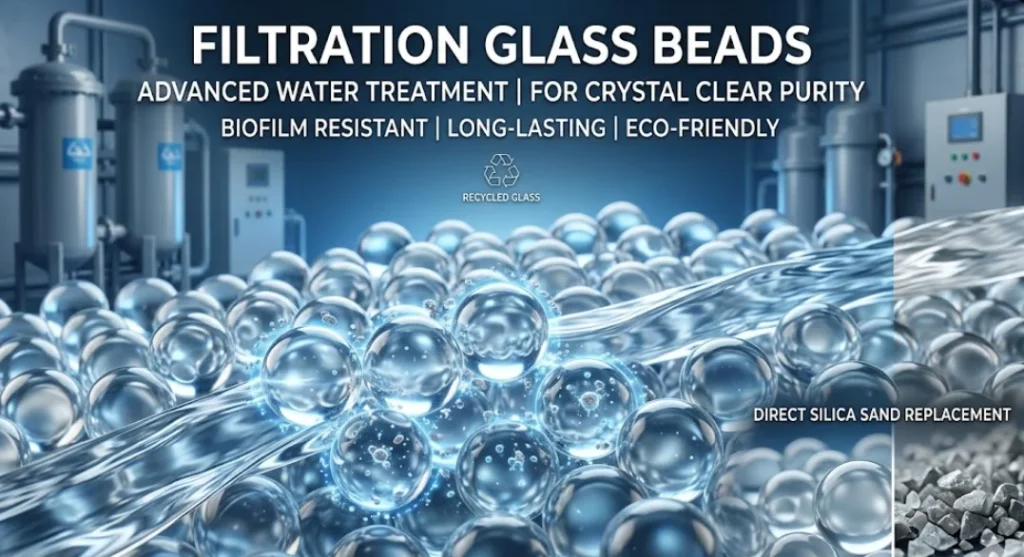
Filtration glass beads are advanced, highly efficient water treatment materials manufactured from 100% recycled and thermally polished glass. By acting as a direct replacement for traditional silica sand, these perfectly spherical beads leverage an ultra-smooth surface and a slight negative electrostatic charge to capture microscopic impurities. Designed for longevity and superior clarity, this media prevents internal biofilm buildup, thereby reducing chemical demand and making it the top choice for modern water purification systems.
The Physical Principles of Glass Pearl Filter Media
The superior performance of glass filtration relies on a combination of mechanical capture and physical chemistry. Traditional granular media relies on jagged edges to trap debris, which eventually leads to clogging and bacterial colonization. In contrast, smooth glass spheres create tightly packed, uniform microscopic flow channels.
Furthermore, the surface of the glass possesses a weak negative electrostatic charge, known as the Zeta potential. This natural physical property acts like a magnet, attracting positively charged fine particles, organic matter, and heavy metal ions from the water stream. Test data from field applications demonstrates that this dual-action principle easily filters out particulates as small as 3 to 5 microns, a massive improvement over the standard 20-micron limit of silica sand.
Core Advantages from the Field
One of the most noticeable benefits observed in real-world fluid management is the drastic reduction in maintenance overhead. Because the spherical shape prevents debris from becoming deeply embedded, backwashing cycles require up to 25% less water and finish in half the time. This translates to significantly lower energy consumption for circulation pumps.
Additionally, the self-sterilizing nature of glass prevents the dreaded “channeling” effect. Without microscopic pores for bacteria to hide in, biofilm simply cannot form on the media bed. This chemical-resistant property extends the lifespan of the recycled glass filter media to over ten years, eliminating the costly and labor-intensive process of replacing filter beds every few seasons.
Production Process and Industrial Applications
Manufacturing these precision beads involves strict quality control and high-temperature processing. Cleaned recycled glass is crushed and then fed into a rotary kiln at temperatures exceeding 850°C. This intense heat melts the jagged edges, forming perfectly spherical pearls while simultaneously burning off any residual organic contaminants, ensuring absolute sterility.
Due to their robust physical integrity, these beads are deployed across highly demanding sectors. Beyond standard residential pool setups, large-scale industrial cooling towers rely on them to prevent scaling and fouling. Municipal water treatment facilities and wastewater reclamation plants also integrate this media to handle high-flow volumes while maintaining strict environmental compliance standards.
Material Comparison: Glass Beads vs. Traditional Media
When evaluating upgrade options for commercial water purification systems, hard data often dictates the purchasing decision. Below is a clear baseline comparison derived from typical operational metrics:
| Feature/Metric | Filtration Glass Beads | Traditional Silica Sand | Zeolite / DE Powder |
| Filtration Fineness | 3 – 5 Microns | 20 – 30 Microns | 2 – 5 Microns |
| Lifespan | 10+ Years | 3 – 5 Years | 1 – 3 Years |
| Backwash Water Usage | Low (Saves up to 25%) | High | Very High |
| Biofilm Resistance | Excellent (Smooth Surface) | Poor (Porous Surface) | Moderate |
| Initial Cost | Moderate to High | Low | High (Ongoing replacement) |
Frequently Asked Questions (FAQ)
Can glass beads be used in any standard sand filter?
Yes, glass media is a direct drop-in replacement. However, because glass is roughly 20% less dense than sand, the total weight required to fill the existing filter tank will be slightly lower. It is recommended to fill the tank to the manufacturer’s specified volume line rather than matching the exact weight of the old sand.
Does upgrading to glass media lower chemical costs?
Absolutely. Since biofilm cannot attach to the smooth glass surface, chloramines and other byproducts are significantly reduced. Facility managers consistently report a 15% to 20% reduction in chlorine and algaecide consumption after making the switch.
Is there a risk of glass particles washing into the water supply?
No. The thermal polishing process creates highly durable, fracture-resistant spheres. Unlike crushed glass with sharp edges, these beads do not degrade, splinter, or break down under normal hydraulic pressure, keeping the downstream water completely safe.